The Lancer check engine light came on and it went into limp home mode.
My daughter rang me, I went out to rescue her, I took a bag of tools and oil and water - I figured she might have cooked it.
On arrival I plugged in my ODB2 reader and found error P2135, which means the throttle position sensor A isn't agreeing with sensor B. There wasn't much I could do about it on a Sunday evening, but conveniently she broke down next door to a mechanic.
Skipping ahead 3 weeks, the mechanics have given up and the car has been towed to my driveway.
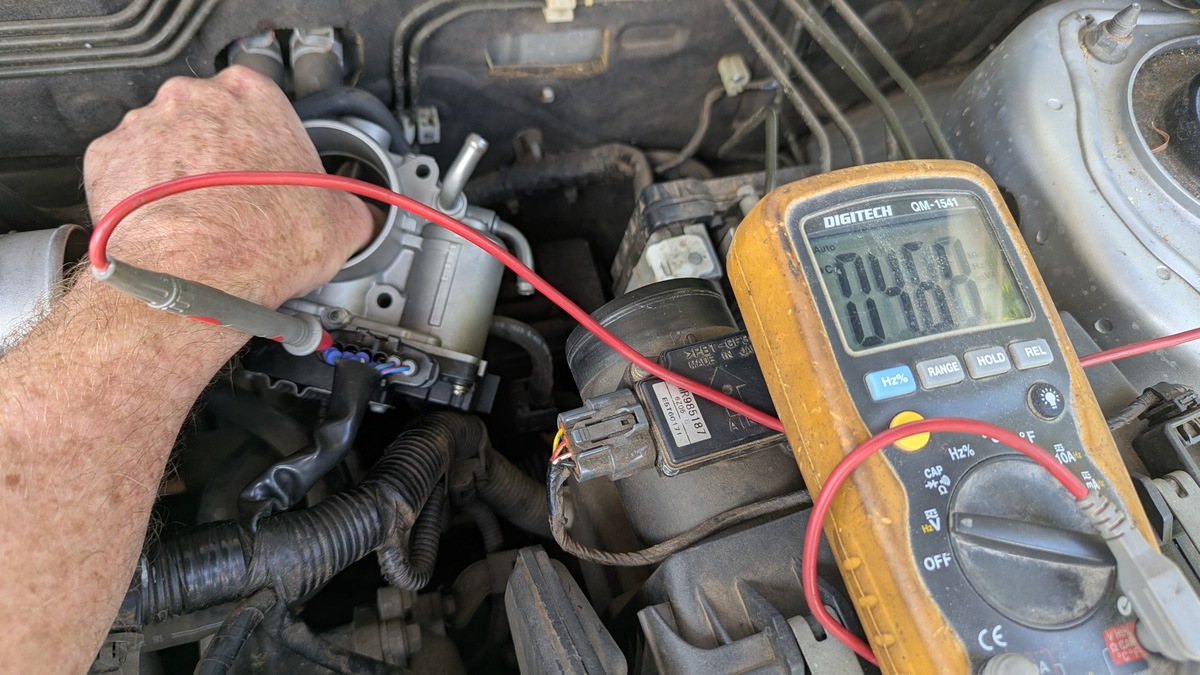
Check position voltages at throttle body
Look it was fair enough, they had swapped out the accelerator position sensor, they had swapped out the throttle body, they got in an auto sparky and the verdict was "corrupt ECU". Sounded like a cop out, but their next step - a new ECU - was going to cost more than the car was worth.
Okay, I'm up for a challenge.
Here's the things I checked:
- ODB2 TPS sensor showed 9%, pressing the accelerator had no effect. Disconnect the battery (to reset the ECU) and the TPS shows 0%, pressing the accelerator had no effect.
- Throttle body connected - four pins - 0V, 5V, sensor A and sensor B. Sensor A was going from 1.2V at open to 4.5V, sensor B was going from 3.2V to 4.5V. That does not seem right.
- Disconnect the throttle body - two pins are the main solenoid and they measured 3.4 Ohms, close enough. Between sensor A and sensor B was 330 kOhm. You would think there should be no connection between the two sensors.
- Disconnect the ECU. Between sensor A and sensor B the resistance had dropped to zero.
With some additional research (noting that the mechanics told my daughter they had tried swapping the accelerator position sensor and the throttle body) and a chat on the phone to a local ECU guy thrown together with some eager chatbot chats I decided:
- The throttle body is okay.
- The accelerator position transmitted is okay.
- The wiring from the throttle body to the ECU is okay.
- Indeed, it would seem the problem must be with the ECU.
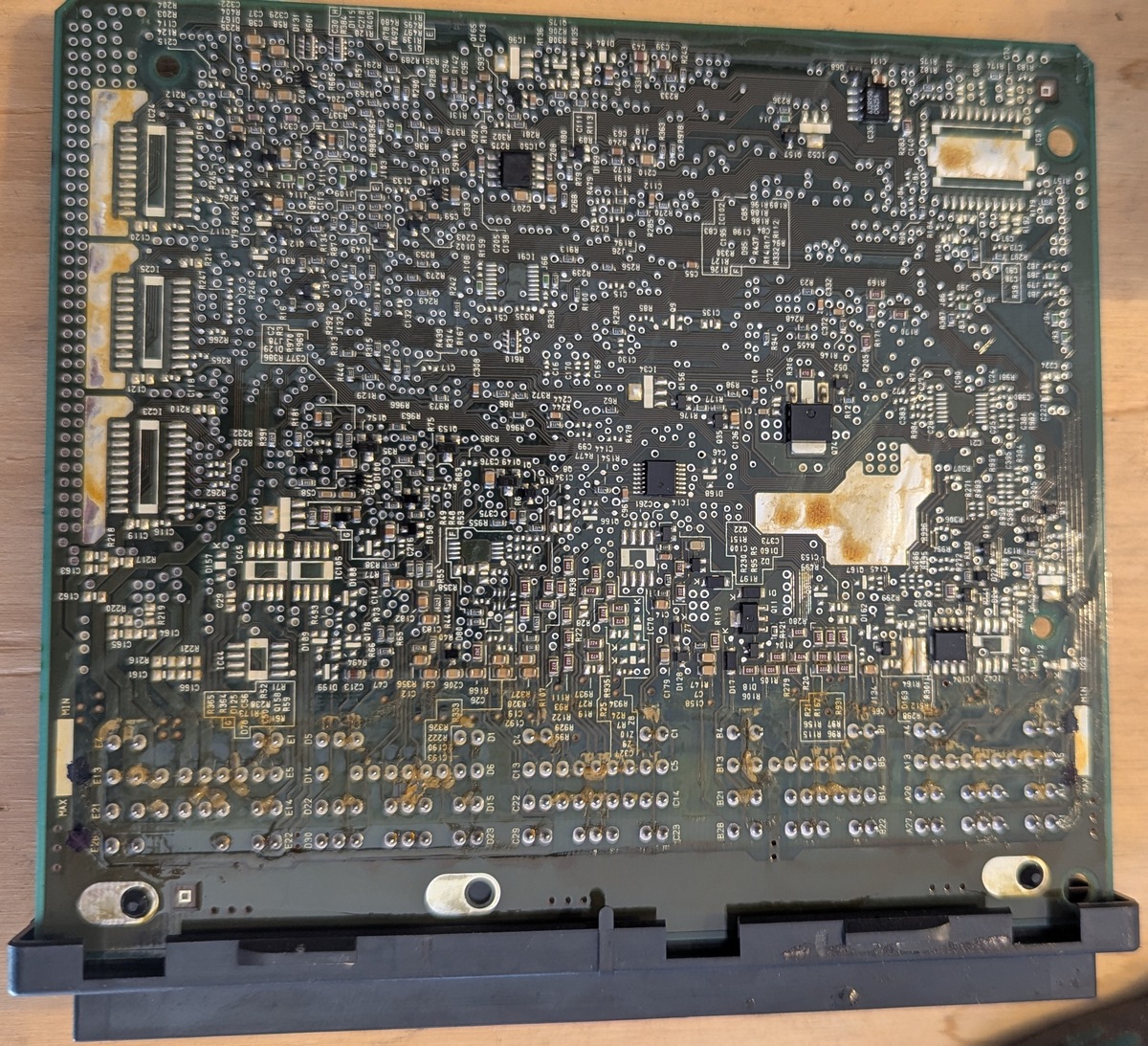
Board likes a bit icky
"Corrupt" is the wrong word. I would say the software on the ECU is working exactly as intended. It is not getting a correct match between the throttle body position sensor A and B, so it is playing it safe and only revving to 2,000 rpm, sluggishly, so in limp home mode.
I pulled out the circuit board, there was a lot of gunk on it. Didn't look like a drink spilled into it, so I could only guess that the conformal coating on the board had broken down and gelled up, running over the place. Going yellow. Possibly resistive? Seems weird that you would coat a circuit board with something that can go conductive - even when broken down - but I hit it with contact cleaner and a toothbrush, and then washed it under water with some detergent. The gel came off, I dried it out in the sun, the resistance across the sensors changed from 330k to 440k. I tried it again in the car, yeah, nah.
At this stage I was quite certain that there was some component(s) on the board that had failed. I did a bit of testing with my multimeter, for anyone who cares, on the Mitsubishi 1860A720 ECU the D23 and D26 connections are the throttle sensor A and B connections. I traced the signal back to some surface mount caps and resistors, started making a sketch - but even if I did reverse engineer the circuit and made sense of it I don't have a supply of SMDs, nor a decent soldering iron, nor a decent magnifying glass, that circuit board is miniature and complex!
I began to search for another ECU.
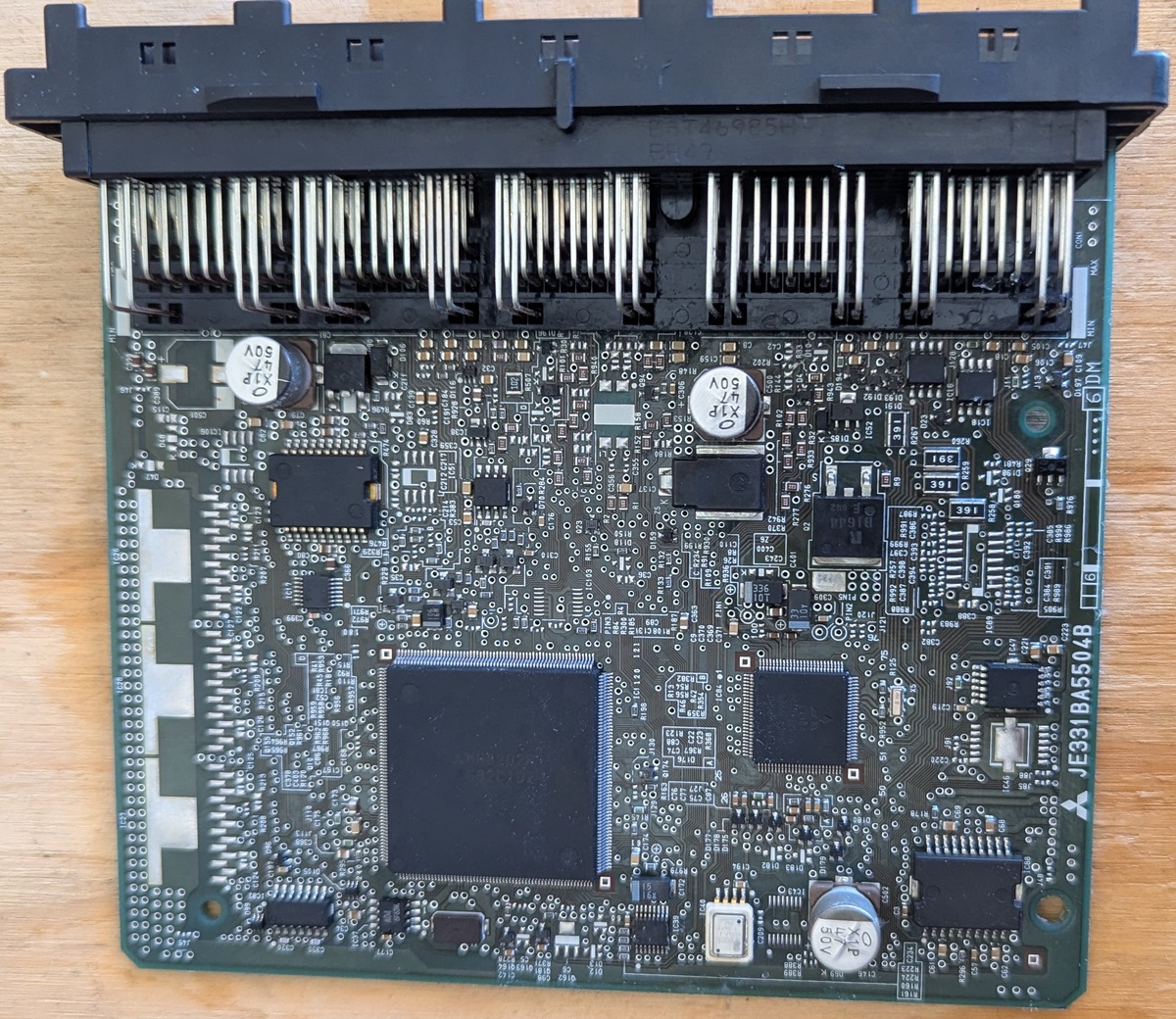
A cleaner board - other side
Talking to wreckers, nobody in Australia has an 1860A720 available. Even if they did and I bought one (there was actually one available on eBay) it would have to be reprogrammed to the same security code as the key. The wreckers, for "a full security set" would sell the ECU, the immobiliser ring and ignition barrel with key. Ballpark for just the ECU alone was $250 so I did not pursue the wreckers, I turned instead to the local private sellers.
The car is a series 2 CH Lancer so any car from late 2005 to early 2007 should be okay. They are starting to get thin on the ground, it has been around 20 years. More importantly, it needed to be the same engine (obviously) AND the same gearbox. Apparently the autos are expecting different signals from the auto trans and are therefore not compatible. I found 3 potential donors. The first guy couldn't fid the key. The other two didn't want to sell parts.
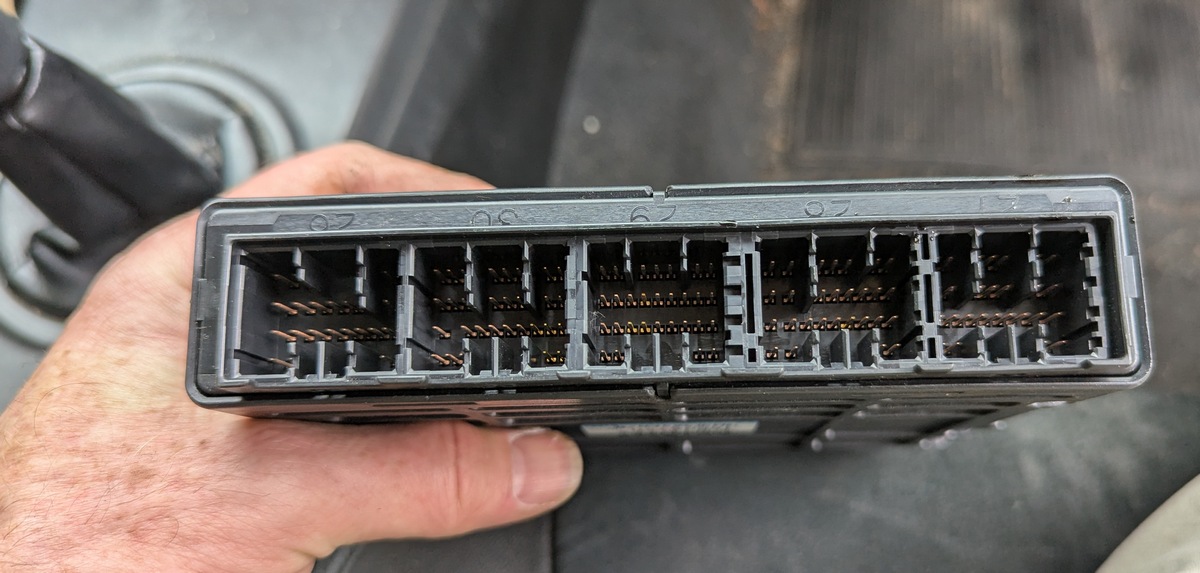
A lot of connectors
It makes sense to me and here's how I reckon it works. If you have an old car, in any condition, the wreckers will pay up to $500 and tow it away for you. So if you just want it gone, easy. If however you want a bit more than $500, then you would advertise it privately. The wreckers with call you like vultures - they need stock - and offer you $500 relentlessly, maybe more - because they will strip it for valuable parts and then send the carcass out for scrap metal. The scrap metal guys pay by the kilo and an old Lancer is $200-300 as scrap. So $500 + a tow (they would have their own tow vehicle) can get them $300 + maybe one or two thousand in wrecking parts. They want that and they make it easy for you.
So it's rare to find one available for spares, it means someone wants more than $500 for a broken car. I was prepared to buy a whole car, take what I wanted, and then sell the rest to the wreckers for $500 like I have done before. I didn't specificaly want to do that, so I offered the first guy $250 cash for the ECU, the imobiliser ring and the key. He said if he could find a buyer that didn't care if those parts were gone he would do it.
After a few days, deal done. I went and picked up the parts.
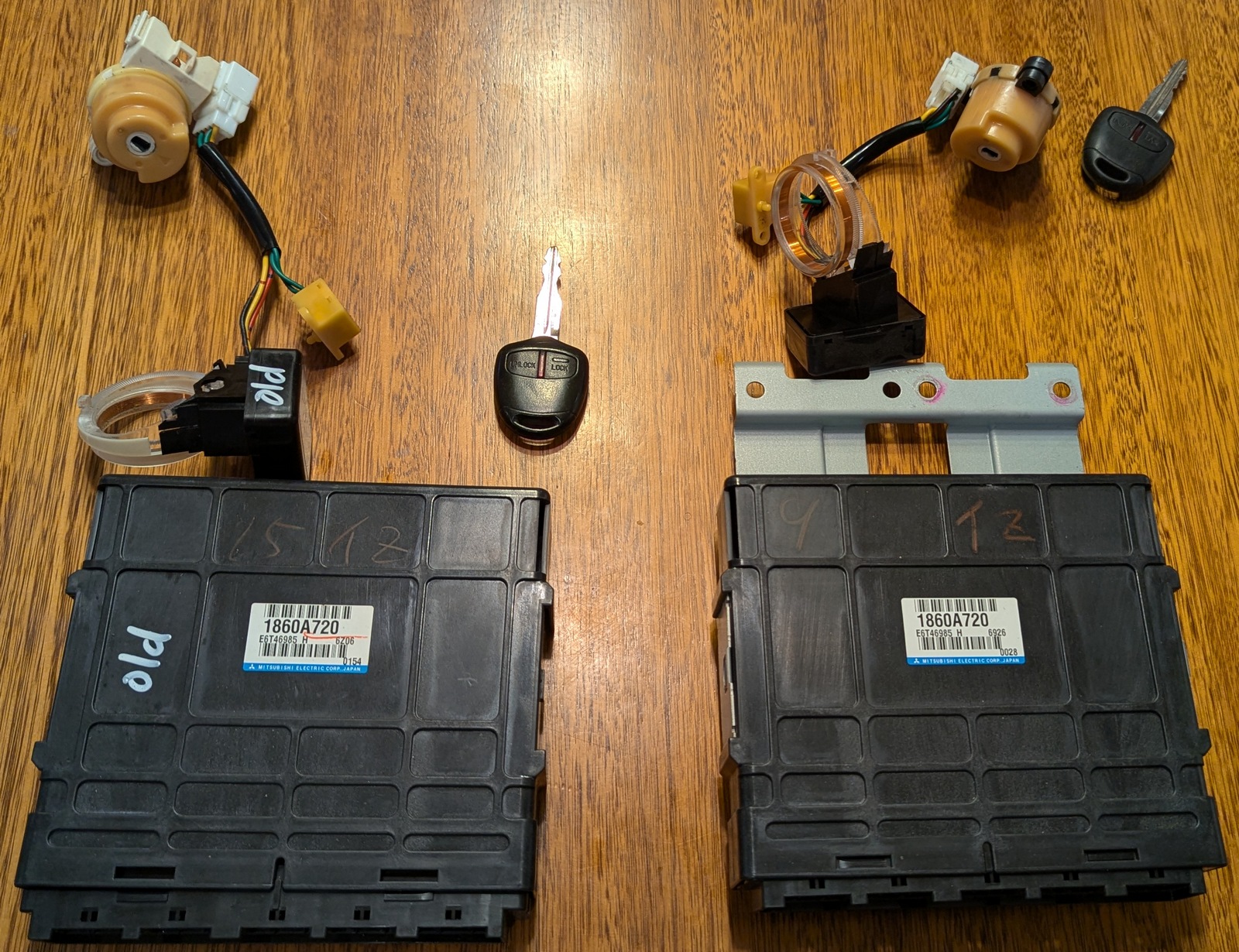
ECU+immobiliser security - old on left, donor on right
Aside - even in 2007, security in cars was definitely a thing. The key has a chip in it, there is a ring around
the ignition barrel with an antenna that will read the chip, maybe or maybe not also do some additional security,
and then a code is send to the ECU. If the ECU and ring and key chip don't all agree, car won't run. The physical
key-ness of the key is as it has been since keys were invented, you won't be able to turn the barrel if it is not the right key for
the barrel - but that is a purely mechanical thing. And besides, you keep your existing mechanical key but swap in the chip.
...so modern car systems, with the can busses and the fancy stuff, share the secret codes between all the computers,
so the ECU would have to talk with the transmission, the windscreen wipers, whatever. So that would be a different
kettle of fish. So "luckily" on this older car I should be right with the ECU/immobiliser ring/key transponder chip.
...whether or not I actually needed to install the imobiliser ring is unknown. It could be just an antenna, and the key code is
passed to the ECU, and the ECU is separately programmed. That would be weird, each ECU would need to be different
for every car...but if the immobilser was coded then they all need to be different...and if the immobiliser just sent
a pass-fail to a common ECU then it would possibly be easy to hotwire...
hence I decided just get all three just in case. Because I can.
I look forward to the day when we get back our Right to Repair...a 2007 Lancer security swap is challenging, a modern car would be un-possible.
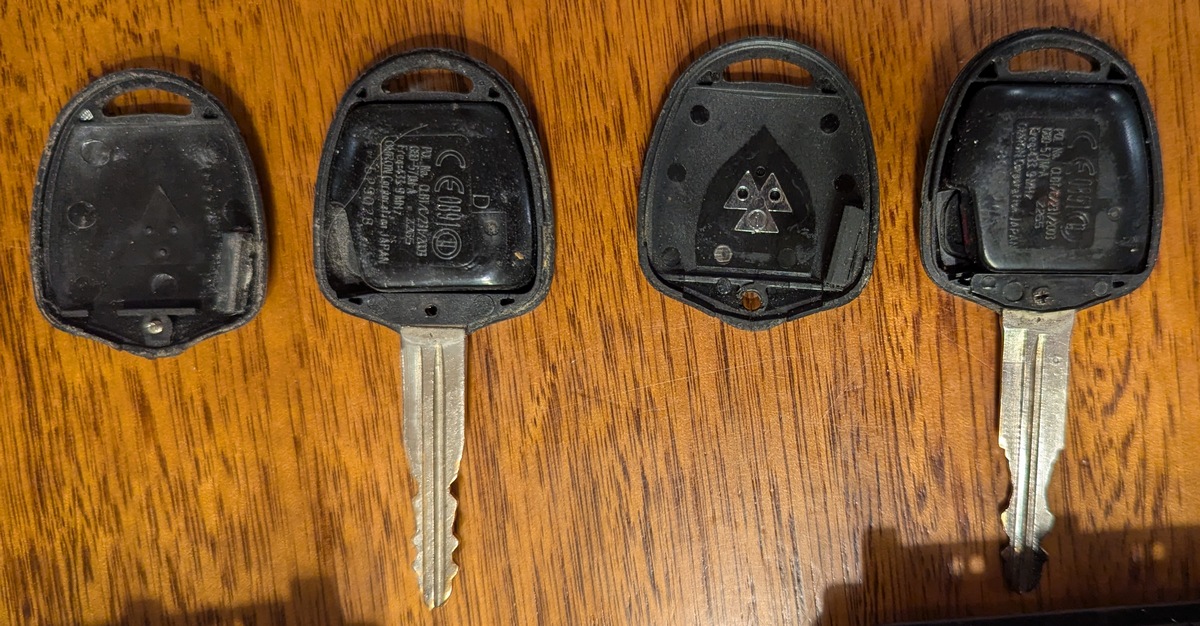
Key chip swap
With the battery disconnected I swapped the key chip into the existing key, put in the ECU (behind the glovebox - note - on one side of the glovebox is a clip which you can pull forward and it releases that side door catch, the other side you bend in a bit, then the door opens to the floor, unhinging), put in the immobilser ring (note - there is a screw that is difficult to remove but easy to snap the plastic away from - then the immobiliser unclips off with a slight anti-clockwise twist and some space negotiation. More note - three screws under the steering column shroud and then clips between the top half of the shroud and the bottom, just use a flatty screwdrive to give it a nudge).
Connected the battery and I hear the familiar whir-whir-whir as the ECU did a throttle position test. That was promising. Check engine light did not come on. Also promising. Started up just fine, I left it to idle for a while - it started quite high and then slowly dropped to a more normal idle. After several minutes I turned on the highbeams and put the aircon on full blast, to give it a load. Idle was stumbling, after a few minutes it came good. This was all about the ECU relearning the throttle position.
Revved it - all good. Drove it down the street. The response was jerky - still learning. After a couple of laps around the block, so around 5kms, the throttle response was back to normal. Success! Nearly! The speedo wasn't working. The suspension was terrible but was unrelated - I was pretty sure of that! I spent a few hours trying to work out the speedo, gave up - but later that day when my daughter took it for a lap it was suddenly working again! I'll put that down to some anti-odometer tampering protocol which eventually synchronised. As for the suspension, we are putting it down to a 20 year old car with already not great suspension being tied down on a tow truck for 30kms.
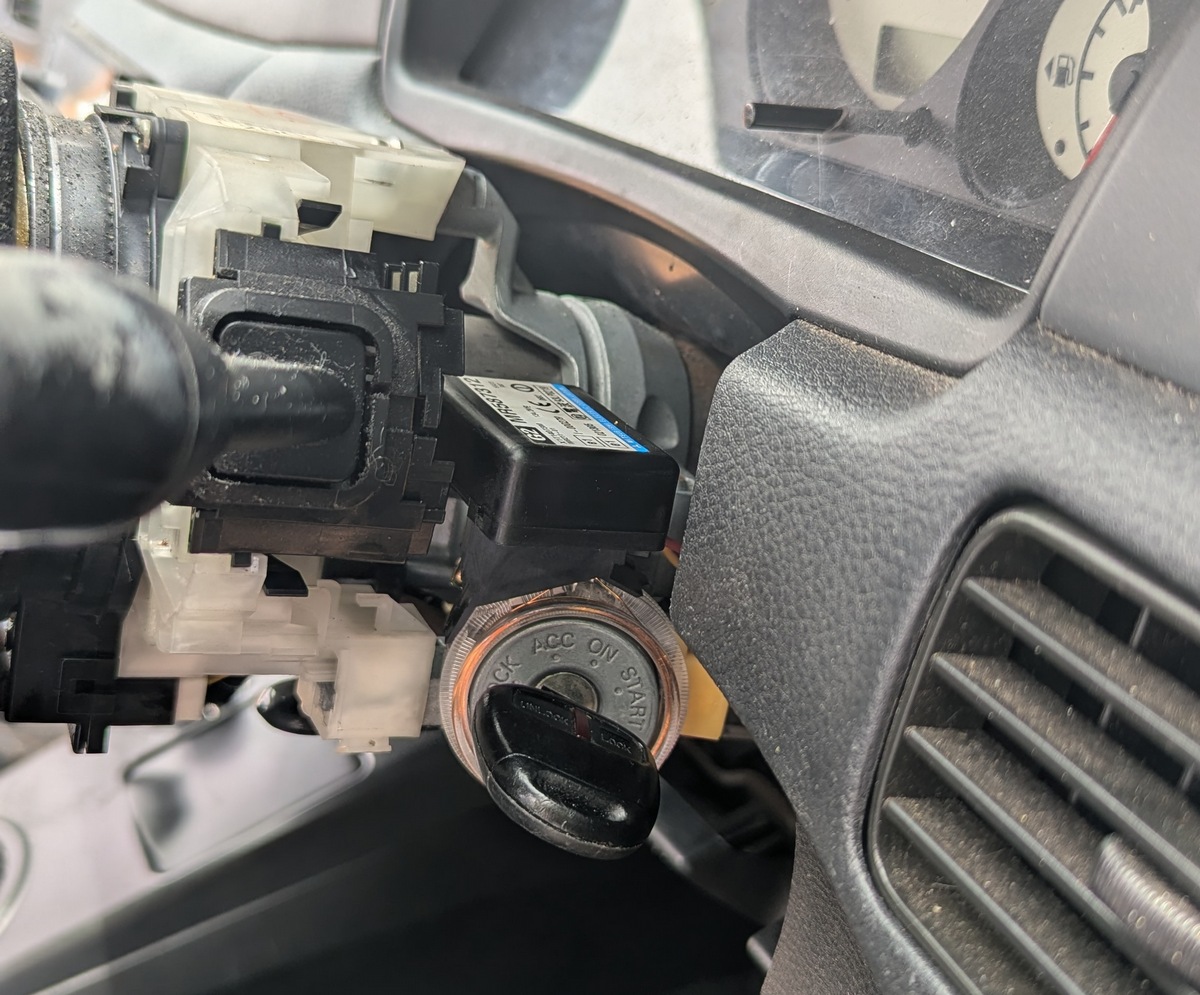
Immobilser ring installed
Was the imobiliser ring required? I don't know, and I'm not going to test it. But I can tell you that the ECU+ring+key chip is enough security transferred from a donor car to a recipient car to keep this car alive. I feel like more modern cars with their fancy canbus won't be so lucky. I can imagine every computer module right down to the windscreen washer pump motor would need to be re-synchronised with a replacement ECU, so this would be a job for the manufacturer. And if your car had that sort of a system and was already 20 years old? I think you write it off.
Good luck out there!


 database